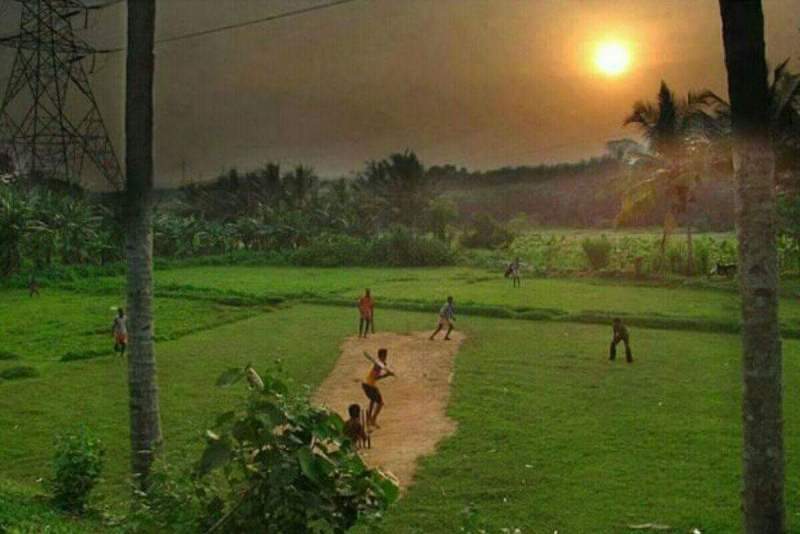
Gully Cricket Wiki – This article is very or very loosely based on one place. Important discussions can be found on the discussion page. Please help improve this article by submitting citations to other sources. Find Sources: ‘Slip’ Cricket – News · Articles · Books · Scholar · JSTOR (November 2014)
The orthodox team leaves the ropes open for the fast bowlers, while the bowlers and wicketkeepers are in the typical squat position.
Gully Cricket Wiki

Three wickets with the wicketkeeper (right). They are slightly away from the batsman because of the speed of the bowler.
Kita Manupakturer’s OP Test Cricket Pillai’s Nations.
In cricket, a slip (string, cord or slip) is placed behind the batsman on the far side of the field. They are placed with the aim of catching the ball with a face out of reach of the goalkeeper. Most teams work with two or three slips (numbered by the batsman closest to the wicketkeeper: first slip, second slip, etc.). A floating board is sometimes used, often with a small game that patrols the part of the dock where there would normally be more than one player. The distance of the frame from the batsman increases with the bat speed. In fact, they will often be further away from the batting line than the wicket keeper. Due to the resulting geometry, players have less slip on the chain than a fast player in a similar playing situation. Because running the slips requires quick turns and a sharp hand, usually the best on the team will slip the rope. Lots of movers are the best butts. Sometimes, a professional slipper is called a “slipper”.
The word slip is also used to refer to the area of the field where the line of scrimmage, or n, stands
Usage refers to the position of the dribbler; for example, a ball can be described as hitting third plate if it goes where third plate would be.
Being the all-time leading wicket-taker in Test cricket, former Indian captain Rahul Dravid is regarded as one of the greatest wicket-takers of all time. Mark Waugh will be considered the greatest of all time, along with other greats of the art including Wally Hammond, Brian Lara, Sunil Gavaskar, Shane Warne, Michael Clarke, Sir Garfield Sobers, Bobby Simpson, Ian Chappell, Jacques Kallis, Brian McMillan, Mark Taylor, Ricky Ponting, VVS Laxman, Mahela Jayawarde, Steph Fleming, Younis Khan and Matthew Hayd, Sir Ian Botham.
How to Play Indoor Cricket: 11 Steps (With Pictures)
A gully is an extension of the slip line in the field which is almost square to the batsman; the area of the field is also called gully. A fielder standing at the crease must stand on a straight line passing from the corner of the batsman’s crease to the middle of the steps towards the wicket. Arthur Jones, who later became head of the guild, discovered the condition of the well in the 1880s at the Bedford Modern School in Bedford. EHD Sewell was quickly enrolled at Bedford School and later gained popularity.
Mouthing the batsman and hitting or slipping the wicketkeeper is theoretically standard practice. To do this, the bowler tries to move the ball away from the expected line and away from the batsman’s body on his side. Outliers or foot-setters or standard-barers are the types of transfers that have this effect. Not surprisingly, bowlers who deliver them effectively have bigger chains than those who don’t.
Sometimes four or five spikes are called for. Gland used sev slips in the first Test against the West Indies and Jamaica in 2004; Australia led the way and used a maximum of nine slips against Zimbabwe in a short batting series in a 2001 One Day International (in this example, the two wickets without slips are the wicketkeeper and the bowler).

A fielder in an even position next to the wicketkeeper is called a leg drop; this is much less common than lateral displacement, and it is unusual for a group to slip more than once. It is illegal, per Rule 41.5, to have more than two fielders in a square foot area at longstop, preventing teams from using the system.
Cricket Fielding Positions
Writing in The Crickets of My Time (1833), John Neer of Hambledon points to the origin of the word ‘slip’, where he describes the role of the longstop as a gardener who is required to cover everything from a bath to both feet. and sides. Size of this sample: 800 × 600 pixels. Other permissions. 320 × 240 pixels |: 640 × 480 pixels |: 1 024 × 768 pixels |: 1, 280 × 960 pixels | 2,560 × 1,920 pixels | 4,608 × 3,456 pixels.
English: From 0500 AM to 1030 AM, the running field is reserved for the public for various games and exercises. On Sundays, the team plays cricket on the polo field for a running competition.
The author of this document has released the work into the public domain, waiving worldwide copyright law, including all associated and related rights to the fullest extent permitted by law. You may copy, modify, distribute and perform the work, even for commercial purposes, without asking for permission.
This file contains additional information, such as Exif metadata, that may have been added by the digital camera, scanner, or software used to create or digitize it. If the file has been modified from its original state, some details such as the time stamp may not accurately reflect the original file. The clock is just like the camera clock and it can be completely wrong. This article is about cricket issues. For other words and games, see Out of the game (sports). For other uses, see Offside (other uses).
How to Understand the Basic Rules of Cricket: 1 Steps
This article requires additional viewing for approval. Please help improve this article by adding links and credible sources. Unavailable items may be challenged and removed. Find sources: “Aside” – Articles · Journals · Books · Scholar · JSTOR (Jan 2021) (Learn how to remove and what to remove this template message)
From a right fielder’s perspective facing the pitcher, it is the right side of the field.
Or half of the field in front of the right-handed batsman where he takes up the batting position. The away side consists of half a tire of the pitch behind the batsman-d wicket, around third man, square of the wicket on his side, cover and mid/long to the non-bowler’s wicket. and behind it a horizontal field. Where the opposition faces a right-handed batsman is the left-hand side of the field. A batsman’s left side is the batsman’s left side and the opposing batsman’s right side.

The diagram shows the pitch for a right-handed batsman approaching from the wicket to the right field. Positions played in this chart include slips, well, dot, cover, middle, third and length. Due to the overall line of attack of the bowlers, away from the side that is going to go. includes fielding position: right leg, square leg, midwicket, middle and, and long and.
England 25th at Stumps v West Indies: Steal Test, Day One
Some of the more common shots called from perspective include horizontal push to distance, cover drive, square cut, time lapse, and third person perspective. Batsman is adept at playing shots from these areas, especially the square hole and covers, and is often a favorite for fans to watch as such shots are difficult to learn. Various batsmen have defined their style and success from other sides, including greats like Sachin Tdulkar, Brian Lara, Garfield Sobers, Kumar Sangakkara, Jacques Kallis, Rohit Sharma, Chris Gayle, Virder Sehwag and Sourav Ganguly.
How to play gully cricket, gully cricket bat, india cricket team wiki, gully in cricket, gel gully 5 cricket shoes, wiki cricket, asics gel gully 3 cricket shoes, gully cricket, cricket wireless wiki, gully position in cricket, what is gully cricket, play gully cricket