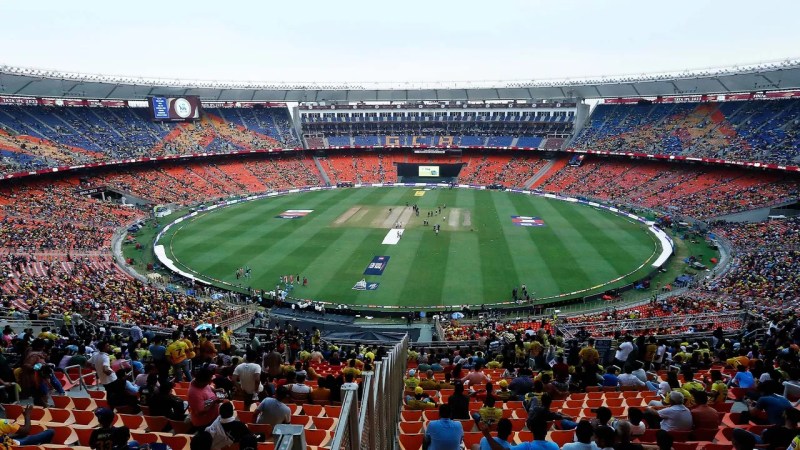
Stadium Names In India – Nardra Modi Stadium, also known as Motera Stadium, is an international cricket stadium in Ahmedabad, Gujarat, India. It is the largest stadium in the world with a capacity of 132,000 spectators.
The stadium is owned by the Gujarat Cricket Association and is a venue for domestic and international cricket matches.
Stadium Names In India

The Nardra Modi Stadium is located on the same plot that housed the Sardar Patel Stadium from 1982 to 2015 until its demolition.
World Cup: Ahmedabad The Newest Power Center In Indian Cricket The New Indian Express
It was the main domestic and international cricket ground in the city until 2015. It hosted several matches in the 1987, 1996 and 2011 ICC World Cups.
The Gujarat Cricket Association (GCA) demolished the Sardar Patel Stadium in 2015 to build the most modern and largest cricket stadium in the world. Nardra Modi Stadium was designed by Australian design firm Populous and built by Lars and Toubro. It took 5 years to build and an estimated cost of 800 kroner (US$100 million). The Ara replaced the legendary Melbourne Cricket Ground as the largest cricket stadium in the world. The headquarters of the GCA is located in its premises. Nardra Modi Stadium has 4 dressing rooms, 11 centers and 2 training pitches which can be used for training as well as home matches etc.
On 24 February 2021, the Gujarat Cricket Association (GCA) named this newly constructed stadium the Nardra Modi Stadium in honor of the current Prime Minister of India, Nardra Modi, who was the President of the GCA (2009–2014) and the Chief Minister of Gujarat (2001–2014).
In 2021, the stadium was inaugurated by the President of India, Ram Nath Kovind, at an event he presided over.
Indian Football: Stimac Names 25 Man Squad
It was first opened to the public in 2020 during the Namaste Trump event organized for US President Donald Trump.
On 24 February 2021, the Nardra Modi Stadium hosted the first Test match, with home team India playing against Gland. It was also his first day-night Test match.
First Home Minister and Deputy Prime Minister of India. Before the Sardar Patel Stadium, international cricket matches in the city were played at the Ahmedabad Municipal Corporation Stadium of the same name (Sardar Patel Stadium) in Navrangpura district. In 1982, the Gujarat government donated 400,000 square meters (100 acres) of land on the banks of the Sabarmati River for the construction of a new stadium. The construction of the Sardar Patel Stadium was completed in nine months.

Since the year, all international cricket matches of the city have been organized here. In the 1984–85 Australia India series, the Sardar Patel Stadium hosted its first ODI in which India lost.
Vishal Kaith In, Dheeraj Singh Out: Igor Stimac Names 23 Man India Squad For Saf Championship
Sunil Gavaskar became the first batsman to score 10,000 runs in Test cricket. He did the feat against Pakistan on their 1987 tour.
In 1983, Kapil Dev took nine wickets against the West Indies in 1983 and took his 432nd Test wicket at the stadium in 1995, surpassing Sir Richard Hadlee’s previous record.
The Sardar Patel Stadium has hosted all the Cricket World Cup matches that India has hosted, including the first match of the 1996 World Cup between England and New Zealand. Although only one match was played at the stadium in the 1987 and 1996 World Championships.
In the 1996 tour of India in South Africa (SA), in the first match of the tour, they needed 170 runs to win, Indian fast bowler Javagal Srinath gave an incredible performance taking 6 wickets in just 21 runs to lead his team to victory.
India’s Government Replaces ‘india’ With Ancient Name ‘bharat’ In Dinner Invitation To G20 Guests
In 2006, the stadium became the center of the ICC Champions Trophy and hosted five of the 15 matches. To host the tournament, the stadium was renovated to include three new courts and a new pitch. As part of the train program, floodlights and covered stands were introduced at the stadium.
During India’s 2010 tour of New Zealand, the 1st Test of the series was played at vue, where Kane Williamson scored a hundred on Test debut.
The 2011 World Cup featured three matches, including a quarter-final between Australia and India. Sachin Tdulkar became the first cricketer to score 18,000 runs in ODIs.

US President Donald Trump and Indian Prime Minister Nardra Modi at the Nardra Modi Stadium on February 24, 2020.
Maharashtra Cricket Association Stadium
In October 2015, the stadium was demolished for reconstruction, although some media called it a novel. The total cost of the reconstruction was estimated at 700 crores (₹7 billion (US$88 million)).
However, the final cost was reported to be 800 kroner (US$100 million). Originally planned for completion in 2019, the reconstruction was completed in February 2020.
It is said that the idea of building a new stadium was suggested by Nardra Modi, the president of the Gujarat Cricket Association and the Chief Minister of Gujarat at the time, when it was his dream project.
Just before Modi moved to Delhi after becoming the Prime Minister of India, minor upgrades to the stadium and development of the pavilion structure were discussed. Modi asked officials to build a new bigger stadium instead of renovating a smaller one.
Narendra Modi Stadium Roof Design
After the demolition work began in 2015, the GCA filed a tder application on January 1, 2016 in The Times of India and The Indian Express. Nine bidders showed interest and purchased tender documents, three of which submitted technical and financial offers on time; these were Shapoorji Pallonji Group, Nagarjuna Construction Company and Lars & Toubro. A Tder Commercial Committee (TCC) consisting of nine experts was formed to evaluate Tder. In addition, Mumbai-based civil engineering consultancy STUP Consultants has been appointed as the project management consultant to evaluate the proposals and technical details of each bid in collaboration with TCC.
All three bidders submitted their blueprints, models and technical details of concepts and designs. Due to the size and complexity of the project, bidders were evaluated based on several parameters such as efficiency, resources, time to completion, ease of implementation, etc. Bidders are ranked and weighted according to all parameters.
On 16 January 2017, the Gujarat Cricket Association spearheaded the project, which officially began on the same day. The stadium is planned to be completed in 2 years, and the reconstruction project is estimated at around 700 kroner (93 million dollars).

The stadium was completed in February 2020, and in 2021 it hosted the England-India day-night Test match.
List Of Famous Stadiums Of India, Name And Location
Mumbai-based commercial kitchen consultants ‘Span Asia’ were engaged to work with Populus and L&T on all food and beverage related areas such as concession stands, main stadium equipment, players, VIP/VVIP boxes, corporate lodges, press and media. boxes, pantries, GCA Club and related areas.
Prime Minister Modi inaugurated the 2022 National Games at Ara. In 2020, “Namaste Trump” was organized there for the President of the United States, Donald Trump. The first test match (Gland vs. India) was held at the new stadium, also the first day-night test. It became the home ground of IPL team Gujrat Titan. Vue hosted the 2022 and 2023 IPL finals.
Aras is scheduled to host 5 matches of the 2023 ICC World Cup, including the first and last matches, the high-profile matches of India vs Pakistan and Australia vs Glands.
Ara is built on 63 hectares of land and has 3 test points, one of which has a metro line. There are 76 company boxes, each holding 25 people,
Mumbai Stadium Names
And four changing rooms. Each stand has a food court and catering area, the stadium premises have a cricket academy and training grounds.
A unique feature of the stadium is the LED lighting system on the roof instead of the usual floodlight towers seen in cricket stadiums around the world. LED lights are placed on top of an antibacterial, fire-resistant PTFE membrane that covers 30 meters (98 feet) of the 55 meters (180 feet) wide seating area. The roof was installed by Walter P Moore, specially designed to be light and separate from the seat to be fairly shock resistant.
Lars and Toubro were also main contractors, working with foreign companies from Australia, Japan, Spain, the United States and Italy. They commissioned Australian firm Populous to design the stadium and their architect Andrew James designed the Nardra Modi Stadium. The company is known for designing the iconic Tottenham Hotspur stadium. The two-tiered structure of the Nardra Modi Stadium has been supported from the start by a number of huge “Y-pillars”; which eliminates the need for columns inside the arena and thus gives spectators an unobstructed view of the rubber pitch from every seat in the stadium. Each Y-shaped pillar weighs 280 tons, is about 30 meters high, they were cast in large molds and assembled on the stadium construction site, later many prefabricated parts were installed in this way. The roof fabric was imported from Japan, the LED lights were installed by a Spanish company, the Italian company installed the cables on which the Japanese company installed the roof fabric. The land is 11 ct

Football stadium in india, in stadium advertising, cricket stadium in india, best stadium names in the world, largest stadium in india, biggest cricket stadium in india, stadium chair manufacturer in india, new cricket stadium in india, stadium toyota in tampa, stadium names, all cricket stadium in india, top cricket stadium in india