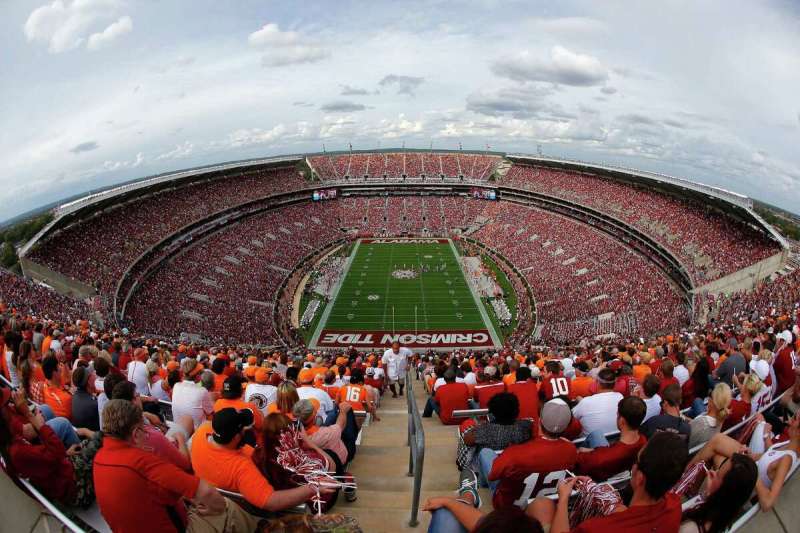
Biggest Capacity Football Stadium – University of Michigan Football Stadium in Ann Arbor, Michigan. It is the largest stadium in the United States and the Western Hemisphere, the third largest stadium in the world, and the 34th largest sports stadium in the world.
) and had an initial capacity of 72,000. Before the stadium was built, the Wolverines played football at Ferry Field. Since November 8, 1975, every home game has drawn more than 100,000 spectators, an active streak of more than 300 contests.
Biggest Capacity Football Stadium

On September 7, 2013, a crowd of 115,109 attended a game between Michigan and the Notre Dame Fighting Irish, the largest attendance for a college football game since 1948 and surpassing the previous NCAA single-game attendance record at the time. A record of 114,804 was set two years ago in this same match.
America’s Incredibly Expensive College Football Stadiums
To keep construction costs low at the time, the decision was made to build a smaller stadium than Yost had envisioned, but with room for future expansion.
Michigan Stadium is used for the University of Michigan’s major graduation ceremonies; President Lyndon B. Johnson outlined his Great Society program at a 1964 stadium rally.
It has also hosted hockey games, including the 2014 NHL Winter Classic, a regular season NHL game between the Toronto Maple Leafs and Detroit Red Wings with an official attendance of 105,491, a record for a hockey game.
Additionally, 109,318 people attended the 2014 International Champions Cup soccer match between Real Madrid and Manchester United, the largest attendance for a soccer match in the United States.
Lane Stadium Is The Largest Stadium In Va
Before playing in Michigan Stadium, Michigan played its games at Ferry Field, which could hold 40,000 people. Fielding recognized the need for a larger stadium after initial expansions at Yost Ferry Field proved too small and persuaded the Regts to build a permanent stadium in 1926. Modeled after the Yale Bowl, the original stadium was built with a capacity of 72,000. Yost originally wanted a capacity of 140,000.
On October 1, 1927, Michigan played Ohio Wesleyan in the first game at Michigan Stadium, easily winning 33-0. The new stadium was officially dedicated three weeks later on October 22nd at a game against Ohio State. Michigan broke the official dedication of Ohio Stadium in Columbus five years ago and won again, beating the Buckeyes 21-0. -only 84,401 people gathered. In 1930, electronic scoreboards were installed, making the stadium the first in the United States to use it to keep official game times.
The addition of the press box in 1956 raised the stadium’s official capacity to 101,001. One “extra seat” in Michigan Stadium is said to have been reserved for then-athletic director Fritz Krisler.

Since then, all official Michigan Stadium capacity numbers have shown “-01”, although the location of the additional seating has not been specified.
Top 10 Largest Capacity College Football Stadiums
Until 1968, Michigan Stadium had a “no girls or boys allowed on the field” policy. Sarah Krulwich, now a photojournalist for The New York Times, was the first woman to take the field.
Longtime Michigan Stadium radio announcer Bob Ufer said, “The hole Yost dug, Chrisler paid for, Canham carpeted and Schembhler filled the cotton fields every Saturday afternoon.”
Since November 8, 1975, the stadium has held more than 100,000 fans for each home game (the Indiana University contest on October 25, 1975 drew “only” 93,857 fans).
The size of Michigan Stadium doesn’t really stand out from the outside, as most of the seats are below ground level.
World’s Biggest Stadium: Know Which One Tops The List
Michigan’s game against Ball State University on November 4, 2006 was the 200th in a row with more than 100,000 fans.
When the game was announced, public address announcer, the historic Howard King, thanked the fans “for being a part of the largest crowd to watch a football game anywhere in America today.”
On September 9, 2006, attendees at Michigan’s football game against Central Michigan Chippewa experienced the first weather delay in the stadium’s history after nearby lightning struck the first quarter and the game was suspended for an hour.

On September 3, 2011, Michigan and Western Michigan lost a game with 1:27 left in the third quarter due to a lightning delay. It was the first time a football game was affected by lightning in Michigan. The stadium was evacuated at 18:38. and the game was called shortly after 7:00.
The 20 Biggest Football (soccer) Stadiums In The World
On June 21, 2007, the university’s Board of Governors approved a $226 million rotation (equivalent to $309 million in 2022).
) and the Michigan Stadium Expansion Project. The project included replacing some of the bleachers, widening the lanes and individual seats, installing handrails, adding a new press box, 83 luxury boxes and 3,200 club seats. The rover plan drew opposition from a small number of creationists, alumni and supporters around the country, who weakened as the rover neared completion from the outside.
A group of disabled veterans filed a federal lawsuit against the university on April 17, 2007, alleging that the project’s design did not meet federal standards for wheelchair seating.
On March 11, 2008, as part of a settlement of a lawsuit against the university under the Americans with Disabilities Act, the university announced that the stadium’s official capacity would be reduced starting in 2009 to include an additional recliner for seating. June.
Florida Planning Ben Hill Griffin Stadium Renovations, Reduction In Capacity
Rotations in April 2008 caused that year’s University of Michigan graduation ceremony to be moved to Diag.
Michigan Stadium was rededicated on September 4, 2010 before Michigan’s first home football game of the 2010 season against the University of Connecticut.
After the rotation, the stadium had no permanent lights, although platforms for temporary lights were included in the design. In September 2010, days after the reassignment, the University of Michigan’s Board of Regents approved plans to add permanent lighting at a cost of $1.8 million (equivalent to $2.37 million in 2022).

). The lights were used for the first time on December 11, 2010 in a hockey game. Next season, the first night football game at the stadium was held on September 10, 2011. The Wolverines beat the Irish 35–31 against Notre Dame.
Ranked: Biggest Sports Stadiums In The World By Crowd Capacity
Michigan’s lacrosse program was promoted to NCAA varsity status in the spring of 2011, effective for the 2011-12 academic year.
The team played most of its 2012 games at Michigan Stadium, including a game against Ohio State on April 14, 2012 following the annual Wolverine spring football game.
By June 2023, new video boards have been installed in the north and south d zones. Each of the oversized slabs is 152 x 55 feet (46 x 17 m) or 8,360 square feet (777 m).
), the third largest in college football and one of the largest in the world, behind the video boards at Jordan-Hare Stadium and Ross-Ade Stadium.
Mountain West Football Posted Its Highest Per Game Attendance Since 2017. Here’s Why
The new video boards were part of Michigan’s $41 million athletic department renovation, which also updated the production room and sound system and installed a new LED stadium lighting system.
Renovations also include replacing video boards at Alumni Field at Carol Hutchins Stadium, home of Michigan softball, Cliff Ke Ara, Michigan gymnastics, women’s volleyball and wrestling; Phyllis Ocker Field, home of field hockey in Michigan; Ray Fisher Stadium, home of Michigan baseball; and SU Football Stadium, home of Michigan football and women’s soccer.
The original capacity of the stadium was 72,000, but Fielding Yost arranged for the foundations to be built, allowing for an expansion of over 100,000 seats.

Originally, each seat consisted of wooden beams. They were replaced by permanent metal seats in 1949 by Fritz Kreisler, who was the athletic director at the time. From 1927 to 1968, the field of the stadium was natural grass. This was replaced by 3M TartanTurf in 1969 to give the players better traction. However, the surface was considered unforgiving by the players, and the stadium was converted to natural grass in 1991. This also became a problem, as the site’s underwater location below the surface made it difficult to remove the grass. permanent root. The playing field was replaced in 2003 with FieldTurf, an artificial surface designed to provide grass-like playing characteristics.
Texas’ Largest High School Stadiums
Michigan Stadium holds the NCAA single-season average home attendance record of 112,252 fans per game in 2012.
On September 7, 2013, Michigan Stadium drew a crowd of 115, 109 to watch Michigan defeat Notre Dame 41–30, which at the time marked the NCAA college football attendance record since 1948. Previously, and before NCAA records were kept for attendance, a 1927 Notre Dame-USC game at Soldier Field in Chicago drew an estimated 117,000-123,000.
Those two records were broken in 2016 when Tennessee and Virginia Tech scored 156,990 points in a game at Bristol Motor Speedway, a NASCAR track with a capacity of more than 150,000.
The Big House also holds the record for the largest attendance at a football game by NCAA Division II, Slippery Rock University of Pennsylvania. In 1959, stadium announcer Steve Filipiak thought it would be funny to include Slippery Rock along with other football scores he read to the crowd because of the school’s unique name. It soon became a tradition and Slippery Rock U
Biggest Football Stadium In The World: Who Can Seat The Most?
Barcelona football stadium capacity, biggest nfl stadium capacity, biggest stadium in the world by capacity, biggest football stadium capacity, biggest stadium seating capacity, biggest soccer stadium in the world capacity, biggest capacity soccer stadium, biggest football stadium capacity in the world, pro football stadium capacity, dallas football stadium capacity, football stadium capacity nfl, biggest stadium capacity in the world